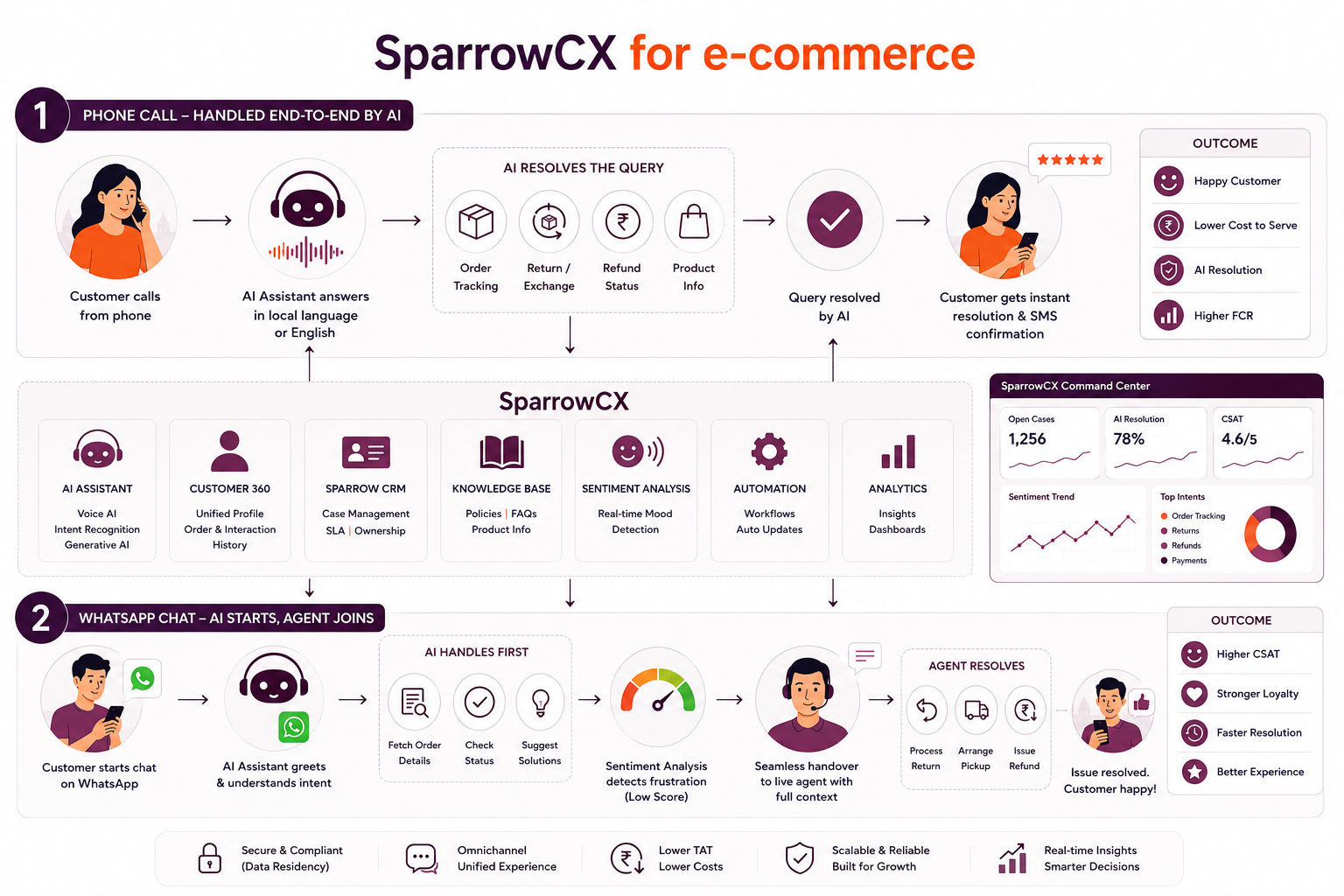
Artificial intelligence is becoming a core part of retail and e-commerce operations. Brands are deploying AI-powered chatbots, shopping assistants, recommendation engines, agent copilots, and predictive analytics to improve customer engagement and reduce operational costs. Yet customer experience has not improved at the same pace, and the gap is becoming harder to ignore.
Qualtrics XM Institute estimates that poor customer experiences could put nearly $3 trillion in global sales at risk as consumers reduce or stop spending after negative interactions.
The pressure is showing up across the journey. Customers still repeat information when they switch channels, wait for answers to simple questions, and abandon purchases when help is not available at the moment of intent. Service teams, meanwhile, continue to search across multiple systems to understand a customer’s history before they can solve a problem.
This is why isolated AI investments often fall short. Most are designed to improve individual functions instead of improving the entire customer journey. That distinction will separate the retailers that simply deploy AI from those that create lasting competitive advantage.
Most AI investments don’t fully solve customer problems
Many retailers introduce AI to improve one metric. They automate FAQs, reduce call volumes, accelerate product recommendations, or help agents respond faster. Those are worthwhile improvements. However, customers do not experience businesses one department at a time. They experience a single journey.
A customer places an order through your website, tracks the shipment through the retailer’s mobile app, starts a live chat when delivery is delayed, receives an email about the updated delivery date, and later contacts customer support to return the item because it doesn’t meet their expectations.
From the customer’s perspective, this is a single journey with one brand.
Inside many retail organizations, it becomes four disconnected conversations managed by different systems. This is where many AI investments fail. They improve individual touchpoints while leaving the overall journey fragmented.
Every handoff increases customer effort, slows resolution, and weakens confidence in the brand.
Successful AI completes customer journeys, not individual conversations
The next generation of retail AI should do more than answer questions. It should understand customer context, make decisions within defined business rules, and complete tasks from beginning to end. Instead of asking customers to navigate business processes, AI should navigate those processes for them.
That means AI should be able to:
- Verify customer identity
- Access order information
- Check inventory in real time
- Initiate returns and exchanges
- Update delivery preferences
- Schedule callbacks when human assistance is required
- Transfer conversations with complete customer context
Customers do not care whether AI or a human resolves their issue. They care that it is resolved quickly, accurately, and without unnecessary effort.
The best customer experiences are proactive
Another reason many AI initiatives underperform is that they simply respond faster to customer requests. The best customer experiences prevent customers from needing to ask in the first place. Retailers can use AI to anticipate customer needs and resolve potential issues before they become support cases.
Examples include:
- Informing customers about shipment delays before they contact support
- Recovering abandoned shopping carts through personalized outreach
- Following up automatically after failed payments
- Notifying customers when refunds or returns have been completed
- Recommending relevant products based on previous purchases instead of generic promotions
These are not one-off marketing campaigns. They are customer experience improvements that reduce inbound support while increasing customer confidence.
AI should make human agents better, not busier
Retailers often measure AI success by the number of conversations that are automated. Customers measure success by how quickly their problems are solved. Human agents will continue to play an essential role in retail, especially when conversations involve exceptions, complex requests, or emotional situations.
The goal is not to replace experienced agents. It is to ensure they receive every conversation with the information they need to resolve it efficiently.
That includes:
- A complete customer history across every channel
- Previous purchases, orders, and support interactions
- Customer sentiment and interaction summaries
- Real-time recommendations during conversations
- Suggested responses based on company policies
When agents spend less time searching for information, they spend more time solving problems. Customers notice the difference.
Technology complexity is often the hidden cost of AI
One of the biggest reasons AI projects fail to improve customer experience is technology fragmentation. Every new AI capability often introduces another platform, another integration, another data source, and another operational process.
Over time, retailers spend more effort managing technology than improving customer experiences. Before investing in another AI solution, retail leaders should ask a few practical questions.
- Does this simplify our technology landscape or make it more complex?
- Can it share customer context across every communication channel?
- Can it automate complete workflows instead of isolated tasks?
- Will it reduce effort for both customers and employees?
- Will it lower the total cost of ownership over the next several years?
The answers to these questions are often more important than the number of AI features listed in a product brochure.
The path forward
The retailers that generate the greatest return from AI over the next few years will not necessarily have the most AI. They will have the simplest and most connected customer experience.
That requires connecting customer data, communication channels, workflows, automation, and human agents into a single, seamless experience. One way retailers are addressing this challenge is by consolidating these capabilities into a unified platform instead of managing multiple disconnected systems.
It also means preparing for a customer journey that may start in an AI-generated recommendation rather than a search result, ad, or homepage visit. Retailers need product information, service policies, reviews, availability, and support workflows to be accurate and connected wherever the customer first forms intent.
Platforms such as SparrowCX reflect this approach by bringing together omnichannel engagement, conversational AI, workflow automation, agent assistance, customer data, and analytics in a single platform. The result is a simpler technology architecture, faster execution, and a lower total cost of ownership.
Ultimately, customers are evaluating how easy it is to buy, get help, and stay loyal. The retailers that remove friction across the entire customer journey, rather than optimizing isolated interactions, will be the ones that deliver meaningful customer experiences and long-term business value.