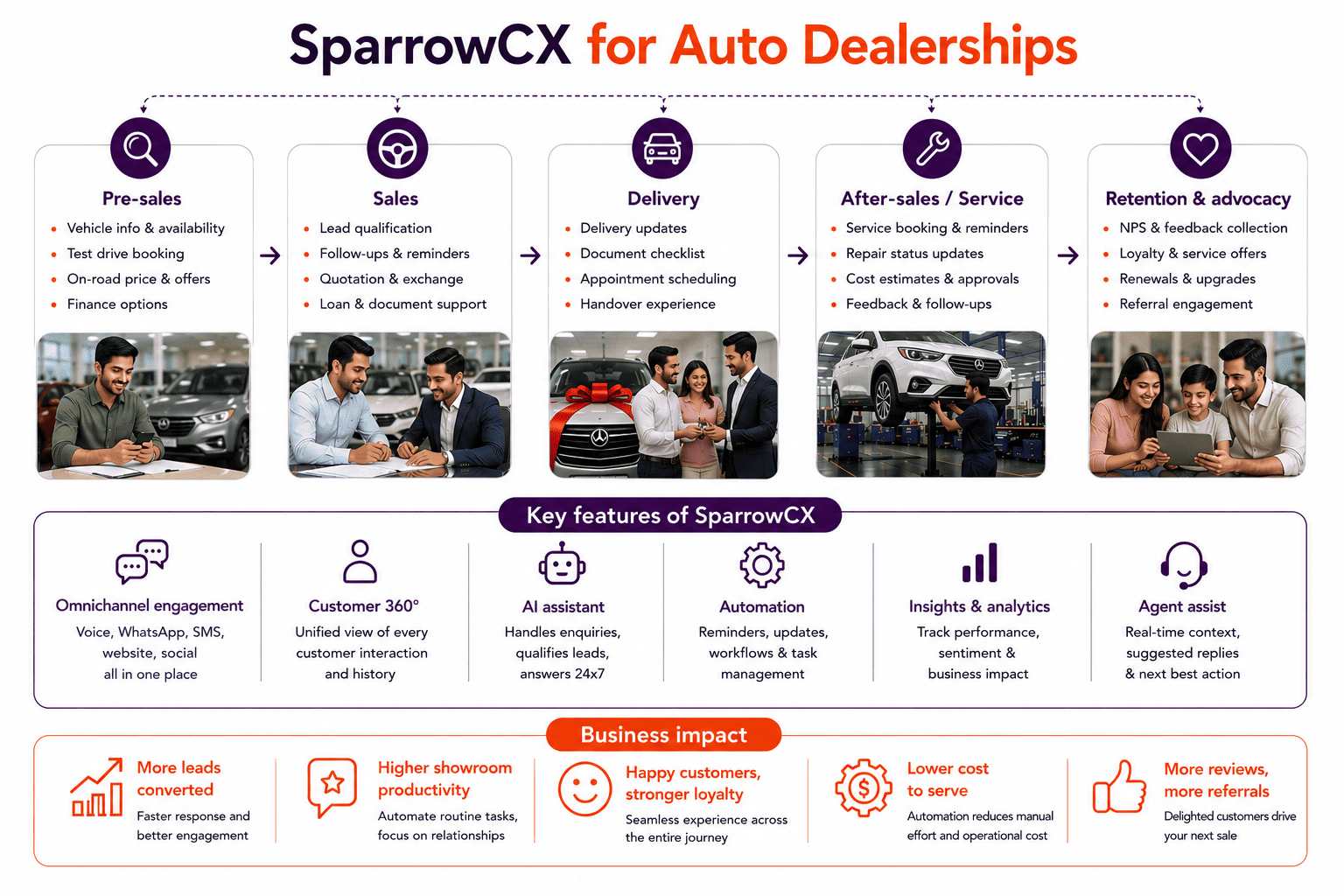
If you are a dealership owner or a general manager, the customer you lose rarely walks out because the car was wrong. More often, they leave because no one called back, the update came too late, or the buying process felt harder than it needed to be.
That is the challenge for modern dealerships: you may win the sale in the showroom, but lose it through poor follow-up, missed calls, slow service booking, or silence between updates.
Customers can compare prices, variants, financing, and reviews before they visit. What they cannot judge until later is how easy you make the journey.
- Did someone answer the phone quickly?
- Did the sales executive call back after the test drive?
- Was the finance process clearly explained?
- Did the customer receive updates while waiting for vehicle delivery?
- Was the first service appointment easy to schedule?
These moments shape customer perception, yet they are also where many dealerships lose consistency.
This journey still depends heavily on phone calls
Even with digital channels, many high-intent customer interactions still happen over the phone:
- Enquire about vehicle availability
- Book test drives
- Compare variants
- Discuss exchange offers
- Understand financing options
- Check delivery timelines
- Book vehicle servicing
- Ask about warranty coverage
- Follow up on repair status.
A missed call or delayed callback can quickly become lost revenue. The phone still matters, but it is only one part of the customer journey. That is why customer experience must be managed across the entire lifecycle, not only at the point of purchase.
But the journey does not end after the sale
Closing the sale is only one milestone. Customers judge the dealership across the full journey, from enquiry to ownership.
A customer sees an Instagram ad, submits an enquiry, schedules a showroom visit, takes a test drive, compares financing, waits for delivery, books the first service, asks about features, and later needs insurance support.
To the customer, this is one relationship. Inside the dealership, it often sits across different teams, tools, and manual processes. When those handoffs are not clearly managed, small delays quickly become visible to the customer.
Small operational gaps become expensive
Dealerships rarely lose customers because of one big mistake. They lose them through small, repeated operational gaps. For example:
- Leads that never receive a follow-up call
- Test drives that are not confirmed
- Customers waiting several days for quotations
- Missed reminders for finance documentation
- Delayed delivery updates
- Service appointments require multiple phone calls
- Customers repeatedly ask whether their vehicle is ready for collection
Alone, these issues seem small. Together, they reduce sales, increase workload, and damage trust. Fixing these gaps starts with making everyday processes easier to track, execute, and repeat.
Better customer experience starts with better processes
Better customer experience does not always require more staff. Often, it requires faster responses, better organization, and less manual work. For example:
- A customer calling to book a service should receive available appointment slots immediately.
- A customer waiting for vehicle delivery should receive proactive updates instead of calling multiple times.
- Sales executives should be reminded automatically when a lead has not been contacted.
- Service advisors should have access to previous conversations before answering a customer’s questions.
- Managers should know which enquiries remain unanswered and which customers require immediate attention.
The goal is not to replace people, but to help them focus on the conversations and decisions that matter most. This is where technology becomes useful: not as a replacement for dealership teams, but as a way to remove friction from their work.
AI works best when it supports the dealership, not replaces it
Dealerships are right to be cautious about technology. Sales and service still depend on trust, relationships, and personal interaction. No dealership wants complicated technology. The best AI initiatives are simple and easy to adopt.
- AI can answer routine enquiries after business hours.
- It can qualify new leads before assigning them to sales executives.
- It can send reminders for appointments, deliveries, and scheduled servicing.
- It can provide customers with instant updates on booking status, vehicle availability, or repair progress.
- It can also assist dealership staff by summarizing previous conversations, recommending next actions, and reducing manual administrative work.
Used well, AI reduces repetitive work so dealership teams can spend more time building customer relationships. For this to work in a dealership environment, the solution must be simple enough for teams to use every day.
Simplicity matters more than features
Complexity slows adoption. Dealerships do not need more disconnected tools for calls, messaging, CRM, scheduling, records, and reporting. They need solutions that fit how their teams already work. Before choosing a customer engagement platform, leaders should ask:
- Will this reduce manual work?
- Can every customer interaction be viewed in one place?
- Can routine customer enquiries be handled automatically?
- Will this improve response times without increasing headcount?
- Will it reduce our long-term operating costs?
If the answer to these questions is yes, the technology is likely to deliver business value.
The dealerships that will lead tomorrow
Customers now have more choice, more price transparency, and fewer clear differences between vehicles. As a result, customer experience is becoming one of the few remaining competitive differentiators.
Dealerships that respond faster, follow up reliably, and make ownership easier will earn repeat business, referrals, and loyalty. That advantage comes from connecting sales, communication, and service into one seamless journey.
Platforms such as SparrowCX support this approach by bringing communication, AI assistance, automation, customer history, and real-time insights into one platform. Instead of adding complexity, they simplify operations and lower the total cost of ownership.