
For decades, customers chose banks based on stability, branch presence, and financial products. Today, those factors still matter, but customer experience has become just as important. People now expect banks to deliver the same speed, convenience, and personalization they experience in other digital services.
Customers no longer compare a bank only to another bank. They compare it to every smooth digital experience they interact with daily. This shift is forcing financial institutions to rethink how they engage customers across channels, services, and support journeys.
The future of banking customer experience will not be defined by isolated support interactions. It will be shaped by intelligent systems that can understand intent, respond proactively, and create seamless journeys across the entire customer lifecycle.
Banking customers expect more than fast responses
Modern banking customers want more than quick issue resolutions. They expect:
- Personalized communication
- Instant access to information
- Seamless omnichannel interactions
- Proactive support
- Consistent service across digital and human touchpoints
- Secure and compliant experiences
At the same time, customer expectations continue to rise while operational complexity inside banks continues to grow. Banks manage large volumes of interactions across voice, email, mobile apps, chat, branches, and messaging platforms. Every interaction generates valuable customer context, but in many organizations, that data remains fragmented across systems.
This creates friction. A few examples include:
- A customer may explain the same issue multiple times across channels
- A support agent may lack visibility into previous interactions
- Customers may wait too long for updates or receive inconsistent information from different teams
These problems are rarely caused by employees alone. More often, they are symptoms of disconnected customer experience infrastructure.
Customer experience in banking is becoming a system design challenge
Customer experience is no longer only about frontline service quality. It is increasingly tied to how well systems, workflows, and data operate behind the scenes. When banking systems are disconnected, customer journeys become fragmented.
When systems are unified, customer experiences become smoother, faster, and more intelligent. This is why banks are investing heavily in technologies that combine:
- AI-powered customer engagement
- Unified customer profiles
- Workflow automation
- Omnichannel orchestration
- Human-agent collaboration
- Real-time analytics
The goal is not simply automation. The goal is to reduce customer effort while improving operational efficiency. Banks that succeed in CX are designing experiences where customers can move naturally between channels without losing continuity.
AI is reshaping banking support operations
AI is playing a major role in this transformation. Traditional support models were reactive. Customers contacted the bank, waited in queues, and depended heavily on manual processes to resolve issues.
Modern AI-powered CX systems are changing that model. AI assistants can now understand customer intent, retrieve information instantly, automate repetitive workflows, and assist agents in real time. This allows banks to handle higher interaction volumes while reducing delays and improving consistency.
More importantly, AI helps banks move from reactive service to proactive engagement. Instead of waiting for escalation, systems can identify customer needs earlier, route conversations intelligently, and trigger the right workflows automatically.
For customers, this creates experiences that feel smoother and more personalized. For banks, it improves operational scalability without sacrificing service quality.
Omnichannel banking is no longer optional
Customers interact with banks across multiple touchpoints every day. A customer may:
- Start with a phone call
- Continue through WhatsApp
- Receive an email confirmation
- Revisit the issue later through mobile banking
Customers expect these interactions to feel connected. They do not want to repeat information every time they switch channels. They expect the bank to remember the conversation context and maintain continuity throughout the journey.
This is where many traditional banking systems struggle. Disconnected tools create disconnected experiences. One channel may have customer history while another does not. Some workflows remain manual while others are automated. As interaction volumes increase, these gaps become more visible.
Unified CX platforms are helping banks solve this challenge by creating centralized orchestration layers that connect customer data, AI systems, workflows, and support teams together.
The best banking experiences combine AI and human expertise
There is often a misconception that AI-driven customer experience means removing people from the process. In reality, the best banking experiences combine intelligent automation with human expertise.
AI works well for:
| Human agents remain critical for:
|
The future of banking CX is not AI versus humans. It is AI and humans working together within connected systems. This balance allows banks to improve efficiency while still delivering empathy and trust where it matters most.
What a modern banking CX flow looks like
A modern customer service flow in banking is no longer a simple support ticket moving through a queue. It is an orchestrated journey powered by AI, automation, customer intelligence, and human collaboration.
The example below illustrates how an intelligent banking CX workflow can operate across channels while maintaining continuity and efficiency.
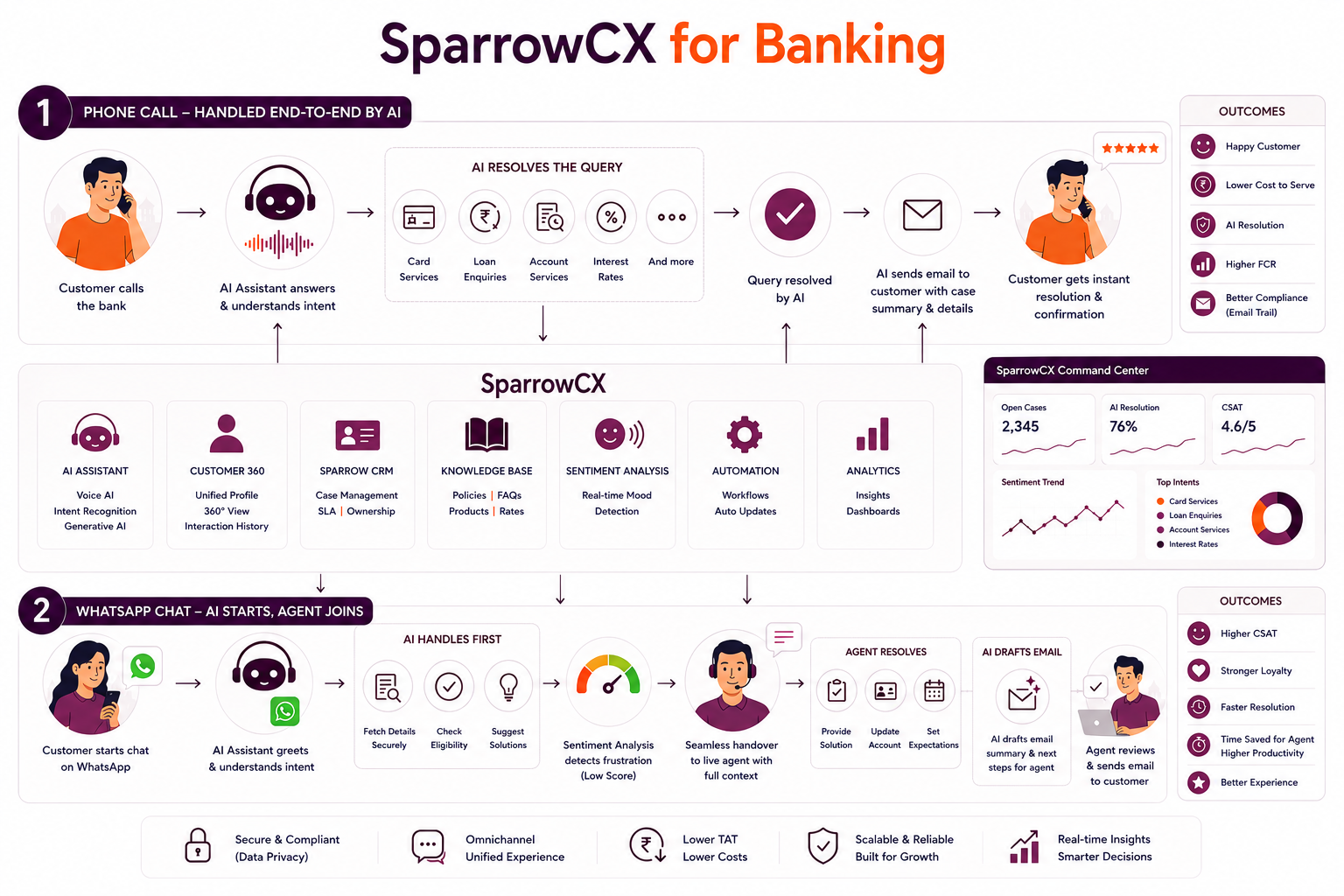
In this flow:
- AI assistants quickly understand customer intent
- Customer profiles provide complete context
- Automation handles repetitive workflows
- Sentiment analysis detects frustration early
- Human agents step in only when needed
- Analytics continuously improve operations
The experience feels seamless to the customer because the underlying systems work together intelligently. This type of orchestration is becoming increasingly important as banks scale digital engagement while maintaining compliance, personalization, and operational efficiency.
Why unified CX platforms matter in banking
Many banks already use AI tools, CRM systems, analytics dashboards, and support platforms. The challenge is that these systems often operate independently. The next evolution of customer experience is not about adding more standalone tools. It is about connecting them into a unified operational layer.
This is where modern platforms like SparrowCX fit into the broader CX transformation across banking. Rather than focusing on a single support channel or automation feature, SparrowCX aims to unify AI assistants, omnichannel engagement, workflow automation, customer intelligence, analytics, and human collaboration into a connected customer experience ecosystem.
The larger industry trend is clear. Banks are moving toward intelligent CX systems that can support scalable, proactive, and context-aware customer engagement across the entire customer journey.
The future of banking CX will be defined by intelligence and trust
Products and pricing can often be matched, but experience is harder to replicate. Customer experience is becoming one of the most important competitive differentiators in banking.
The banks that succeed over the next decade will likely be the ones that can combine intelligent systems with human-centered service design. They will create experiences that feel fast, connected, proactive, and trustworthy across every interaction.