
Sales has always been a people-driven function. The ability to build trust, understand customer intent, handle objections, and guide conversations effectively has traditionally defined high-performing sales teams.
However, the modern sales environment has become significantly more complex over the past few years. Buyers now engage across multiple channels, expect faster responses, compare competitors instantly, and often complete a large portion of their research before ever speaking to a sales rep.
As customer behavior evolves, sales teams face growing pressure to operate faster, smarter, and more consistently without dramatically increasing headcount.
This shift is changing how businesses think about sales productivity. Success is no longer determined solely by the number of agents on the team. Increasingly, it depends on how effectively organizations use AI to support sales conversations, streamline workflows, and improve decision-making in real time.
Modern sales teams are managing more complexity than ever
Today’s sales environments look very different from traditional inbound or outbound call centers. Sales agents now manage conversations across voice calls, WhatsApp, email, SMS, social media, and video meetings.
At the same time, buyers expect personalized engagement across every interaction. They expect sales reps to understand previous conversations, remember preferences, and respond quickly with accurate information. This creates significant operational complexity for sales teams.
In many organizations, sales reps spend large portions of their day switching between tools, updating CRM records manually, reviewing call notes, scheduling follow-ups, and searching for customer context before conversations even begin.
Common challenges include:
- Delayed follow-ups on high-intent leads
- Inconsistent messaging across sales teams
- Manual CRM updates after calls
- Missed opportunities due to lack of visibility
- Poor coordination between channels
- Limited coaching visibility for managers
- Difficulty maintaining consistent pitch quality at scale
Over time, even strong sales teams struggle to maintain speed and consistency across thousands of customer interactions. This is why many organizations are now rethinking the role AI should play inside the sales process
AI is becoming a performance layer for sales teams
Today, AI is evolving far beyond basic automation. Modern AI systems are increasingly acting as real-time performance layers that support sales agents during live customer interactions.
Instead of simply automating tasks, AI can now assist sales reps throughout the entire sales cycle by helping them communicate more effectively, prioritize opportunities intelligently, and respond faster across channels.
This fundamentally changes how sales teams operate. Rather than relying entirely on memory, manual processes, or individual experience levels, sales reps can now receive continuous AI-driven assistance before, during, and after customer conversations.
As a result, AI is shifting from being a back-office productivity tool to becoming an active participant in revenue operations.
Real-time guidance improves sales conversations
Top-performing sales reps often handle objections better, ask stronger discovery questions, and adapt to conversations more effectively than newer team members. However, scaling that level of performance across an entire organization has historically been difficult.
AI-powered sales guidance is beginning to solve this problem. During live customer conversations, AI systems can analyze context, customer intent, and conversation flow in real time to help agents respond more effectively.
For example, during a sales call, AI can:
- Suggest relevant responses to customer objections
- Recommend next-best actions
- Surface important customer history instantly
- Identify buying signals during conversations
- Highlight upsell or cross-sell opportunities
- Detect hesitation or negative sentiment early
This allows sales reps to stay focused on the conversation itself instead of searching for information manually or relying entirely on scripted workflows.
More importantly, AI helps improve consistency across teams by enabling newer agents to perform closer to the level of experienced reps.
Faster follow-ups often determine conversion outcomes
Customers today expect near-instant engagement after submitting inquiries, booking demos, or requesting information online. Delayed responses often result in lost opportunities because buyers quickly move to competitors who engage faster.
AI is helping businesses solve this challenge by improving follow-up orchestration across the entire sales funnel. Instead of relying solely on manual reminders or individual discipline, AI systems can automatically:
- Schedule follow-up tasks
- Trigger reminders for inactive leads
- Prioritize high-intent opportunities
- Generate personalized follow-up messages
- Initiate outbound Voice AI interactions
This creates a more structured and responsive sales process while reducing the risk of missed opportunities.
AI reduces administrative burden for sales teams
One of the least productive aspects of sales operations is administrative overhead. After every customer interaction, sales reps spend time updating CRM records, writing call summaries, logging notes, tagging conversations, and documenting the next steps manually.
AI is increasingly eliminating this burden through intelligent workflow automation. Modern AI systems can automatically generate call summaries, extract key discussion points, update CRM records, log action items, and organize customer interaction history without requiring manual input from sales reps.
This leads to several operational advantages:
- Sales agents spend more time selling
- CRM data becomes more accurate and complete
- Managers gain better visibility into pipeline activity
- Follow-up coordination improves across teams
- Customer history remains consistently updated
As businesses scale sales operations, reducing administrative workload becomes essential for improving both productivity and employee efficiency.
Sales coaching is becoming more data-driven
AI is also changing how organizations approach sales coaching and performance management. Traditionally, managers reviewed only a small percentage of customer interactions due to time limitations. This made it difficult to identify coaching opportunities consistently across large teams.
AI-powered conversation intelligence platforms now allow businesses to analyze sales interactions at scale. Organizations can identify patterns across thousands of conversations, including:
- Common objections
- Successful conversion behaviors
- High-performing messaging patterns
- Customer sentiment trends
- Drop-off points in conversations
- Follow-up effectiveness
Instead of relying only on anecdotal feedback, sales leaders can use operational insights to improve training, refine messaging, and optimize sales processes continuously.
The future of sales will combine human expertise and AI assistance
Despite rapid advances in AI, successful sales still depend heavily on human relationships, emotional intelligence, and trust-building. Complex buying decisions require empathy, strategic thinking, negotiation skills, and personalized engagement that human reps handle best.
However, AI is becoming extremely valuable in supporting these interactions by reducing operational friction and helping sales teams operate more efficiently. The example below illustrates how an intelligent sales workflow can operate across channels while maintaining continuity and efficiency.
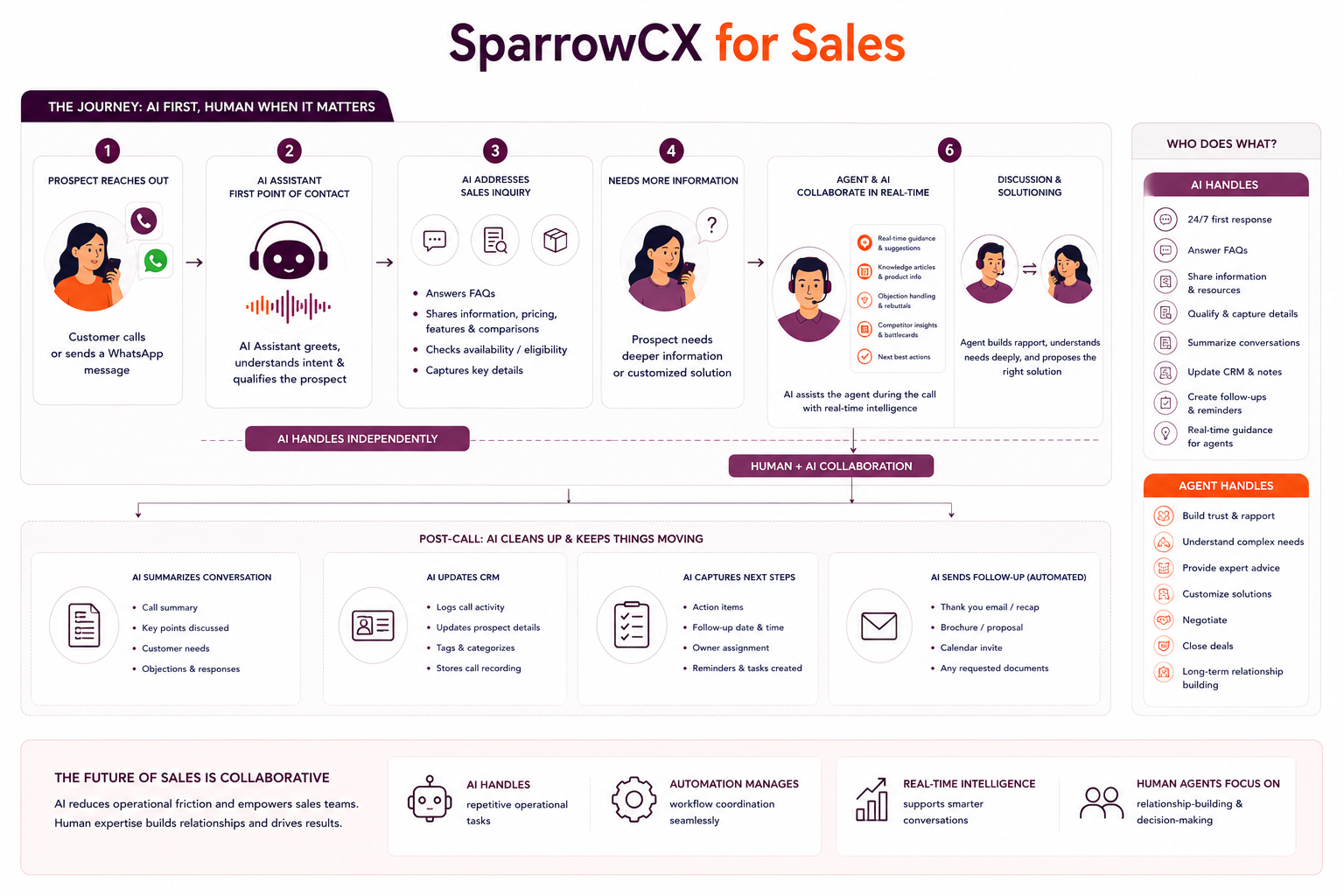
The future of sales will center on collaborative workflows where:
- AI handles repetitive operational tasks
- Automation manages workflow coordination
- Real-time intelligence supports conversations
- Human agents focus on relationship-building and decision-making
This combination allows organizations to improve scalability without sacrificing customer experience quality.
Why connected sales platforms matter
As sales engagement expands across channels, disconnected systems create growing operational inefficiencies. Many organizations still manage calls, WhatsApp conversations, CRM workflows, and analytics across separate platforms. This fragmentation limits visibility and slows down sales execution.
Platforms such as SparrowCX help businesses support sales teams with capabilities such as:
- Real-time conversation guidance
- Suggested responses and next-best actions
- Automated follow-up reminders with Voice AI
- AI-generated call summaries and CRM updates
- Omnichannel customer engagement
- Consistent messaging across teams
Businesses are moving toward AI-supported sales operations that improve productivity, responsiveness, and conversion efficiency without requiring proportional increases in team size.